Articles for the ‘Analog Design’ Category

« Previous Next »

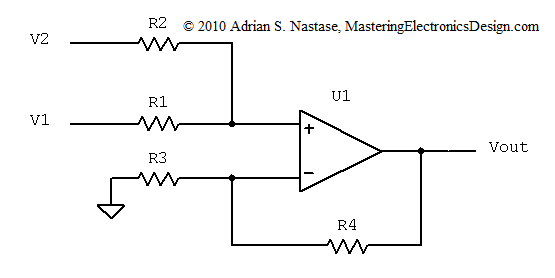
Design a Bipolar to Unipolar Converter with a 3-input Summing Amplifier

Sunday, January 31st, 2010

Summary:

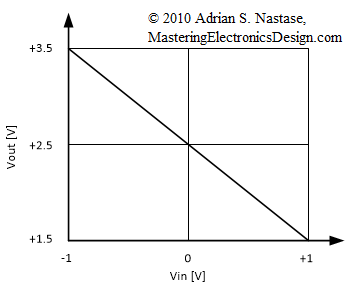
Since the publication of Design a Bipolar to Unipolar Converter to Drive an ADC, several readers contacted me with requests to help in solving their particular converter. The common problem they had was the fact that the components’ calculation resulted in a negative value for at least one resistor.

To provide a solution, first we need to understand the root cause of the problem. Let’s take one of the circuits I received and analyze it.

The reader wrote that he would like to drive an ADC with the input range of 0 to 2.5V from a signal with the range of –5V to +5V, connected at V1.

Read more ...


Tags: , , , , , , , ,
Categories: Analog Design, Electronic Circuits Examples, Summing Amplifier

Summing Amplifier Calculator

Friday, January 22nd, 2010

Summary:

The calculator solves the summing amplifier resistors based on the input and output voltage range requirements. It is a great tool to design a bipolar to unipolar converter, as an example and other circuits.

Read more ...

» 1 Comment


Tags: , , , , ,
Categories: Analog Design, Calculators, Summing Amplifier

How to Design a Summing Amplifier Calculator

Monday, January 11th, 2010

Summary:

In this article, you can download a Summing Amplifier Calculator in the form of a spreadsheet. You can input the voltage range, output range, a reference voltage and a choice of two resistors. The calculator gives you the answer for the remaining resistors. Also, this article explains the mathematical steps towards building the calculator.

Read more ...

» 1 Comment


Tags: , , , , , , , ,
Categories: Analog Design, Calculators, Summing Amplifier

Bipolar to Unipolar Converters Based on a Summing Amplifier Configuration

Monday, December 28th, 2009

Summary:

In a previous article I presented a method for designing a bipolar to unipolar converter using a summing amplifier. In this article I am going to show more examples of bipolar to unipolar converters which are based on a summing amplifier configuration. You can adapt them to your needs if you use the method I described in the previous article.

Read more ...

» 4 Comments


Tags: , , , , , ,
Categories: Analog Design, Electronic Circuits Examples, Summing Amplifier

The Non-Inverting Amplifier Output Resistance

Wednesday, December 23rd, 2009

Summary:

It is customary to consider the output resistance of the non-inverting amplifier as being zero, but why is that? An Op Amp’s own output resistance is in the range of tens of ohms. Still, when we connect the Op Amp in a feedback configuration, the output resistance decreases dramatically. Why?

Read more ...

» 4 Comments


Tags: , , , , ,
Categories: Analog Design, Operational Amplifier Formulas

How to Derive the Inverting Amplifier Transfer Function

Thursday, November 26th, 2009

Summary:

Widely used in Analog Design, the inverting amplifier in Figure 1 has a simple transfer function. What is the proof of this function?

Read more ...

» 2 Comments


Tags: , , , , ,
Categories: Analog Design, Operational Amplifier Formulas

Design a Differential Amplifier the Easy Way with Mathcad

Thursday, November 19th, 2009

Summary:

For those of you who have Mathcad, designing a differential amplifier is really easy.

Let’s say you need to design a unipolar to bipolar converter and you decide to use a differential amplifier for this task. You know the input and output voltage range and you need to calculate the resistors based on a voltage reference you have in the system. All you have to do is to create a Mathcad file for a quick response. Then store it some place for future designs.

Read more ...

» 6 Comments


Tags: , , , , , ,
Categories: Analog Design, Differential Amplifier, Electronic Circuits Examples

« Previous Next »