Articles Tagged ‘3 loop circuit’

How to Apply Norton’s Theorem. Solving Circuits with Independent Sources

Sunday, September 27th, 2009

Summary:

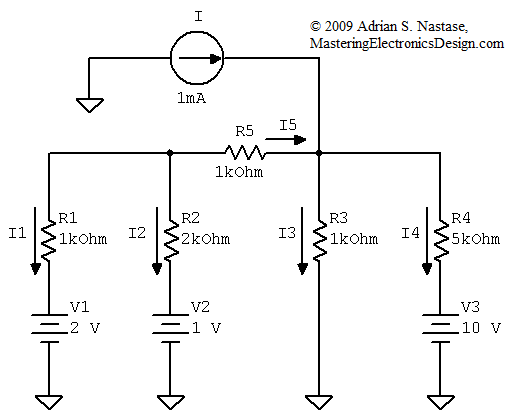
Norton’s Theorem is a powerful tool for solving electrical circuits. Like Thevenin’s Theorem, it simplifies the circuit one needs to study and dramatically reduces potential calculation errors.

Norton’s Theorem states that networks with voltage and current sources, as well as resistors are electrically equivalent to one single current source and one single resistor in parallel with the source. The theorem is valid for AC circuits, where instead of resistors there may be reactive components. Since this theorem sounds very much like Thevenin’s Theorem, one can only imagine that Norton’s current source is equivalent with Thevenin’s voltage source. Indeed, they are equivalent as we will see further.

Read more ...


Tags: , , , ,
Categories: Analog Design, Thevenin's Theorem

How to Apply Thevenin’s Theorem – Part 2. Nested Thevenin Sources Method

Monday, September 14th, 2009

Summary:

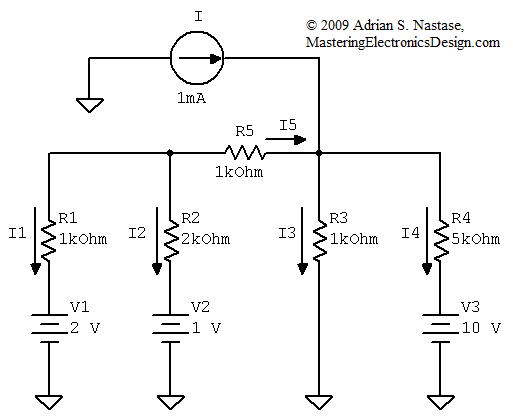
What are Nested Thevenin Sources? I came up with this name recently, while talking to an engineer about a design problem. I just said it, and I liked it. I then went and searched on Internet to see if anybody else used the term Nested Thevenin Sources before. I did not find it so, here it is. Let’s talk about it.

I borrowed the term from “nested loops” in the programming world. The main idea is that you can use a method to accomplish a task inside another method of the same kind, hence the word nested. As we saw in How to Apply Thevenin’s Theorem – Part 1, Thevenin’s Theorem is widely used to simplify the solving of a complex circuit.

Read more ...

» 1 Comment


Tags: , , , , ,
Categories: Analog Design, Thevenin's Theorem

How to Apply Thevenin’s Theorem – Part 1, Solving Circuits with Independent Sources

Monday, September 7th, 2009

Summary:

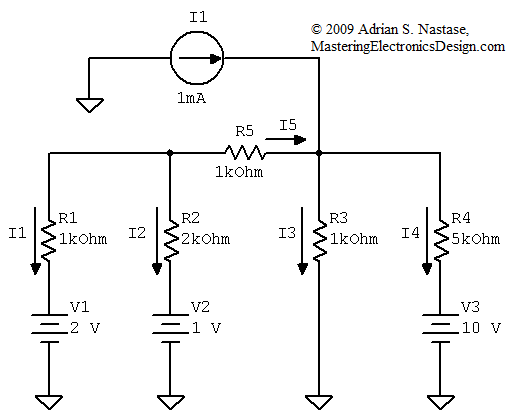
Thevenin’s Theorem makes it easy to study complex networks by simplifying the circuit to be studied. It states that networks with voltage and current sources, as well as resistors are electrically equivalent to one single voltage source and one single resistor in series with the source. The theorem is valid for AC circuits, where instead of resistors there may be reactive components…

Read more ...

» 2 Comments


Tags: , , , , ,
Categories: Analog Design, Thevenin's Theorem