


In a previous article, Design a Bipolar to Unipolar Converter to Drive an ADC, I presented a method for designing a bipolar to unipolar converter using a summing amplifier. In this article I am going to show more examples of bipolar to unipolar converters which are based on a summing amplifier configuration. You can adapt them to your needs if you use the method I described in the previous article.
Input -1V to +1V, Output 0V to +5V, Reference voltage +5V
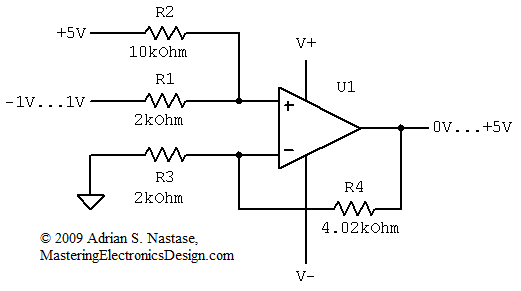
Figure 1
Input -2V to +2V, Output 0V to +5V, Reference voltage +5V
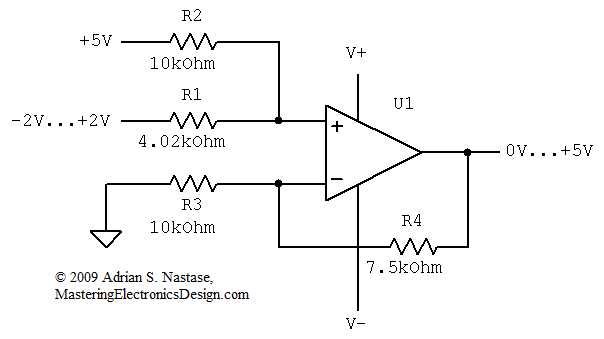
Figure 2
Input -3V to +3V, Output 0V to +5V, Reference voltage +5V
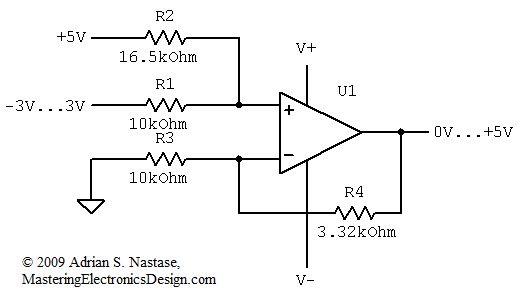
Figure 3
Input -10V to +10V, Output 0V to +5V, Reference voltage +2.5V
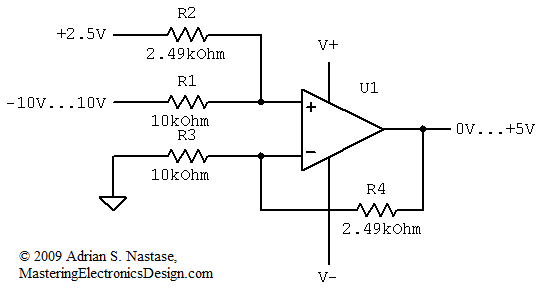
Figure 4
Input -5V to +5V, Output 0V to +5V, Reference voltage +2.5V
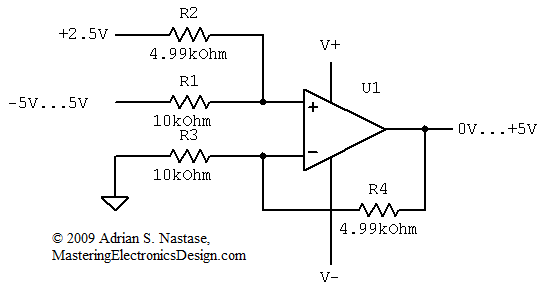
Figure 5
Input -1V to +1V, Output 0V to +5V, Reference voltage +2.5V
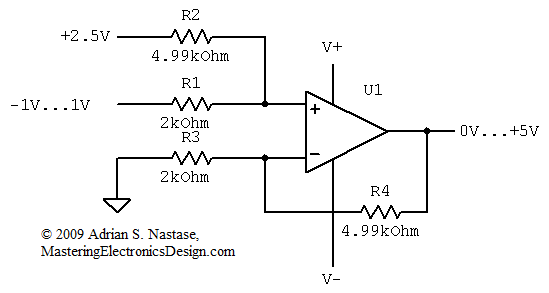
Figure 6


 '
'
Hi,
reading your previous articles on this topic I came up with pretty much the same resistors for the problem shown in figure 4. What I was wondering about is the stability of this circuit. Since the gain v_out/vin is below one, do I have to be careful when choosing the op amp? If I recall correctly there is a pretty good chance of picking the wrong op amp and ending up with an oscillator.
Btw, thanks for this great site!
khor, you’re welcome and thanks for visiting.
As for your question, yes, one needs to choose the op amp carefully. Op amp manufacturers show in their datasheets the gain and phase bode plots as well as the phase margin versus frequency. Typically, if you choose a unity gain stable op amp it has less chances to oscillate below unity gain. However, as manufacturers try to boost the gain as much as possible, due to competition, the op amp internal compensation may be just about right to make sure the phase margin is above 45 degrees all the way down to 0 dB gain. Below 0 dB gain, one might see an extra pole and that means trouble. Therefore, since there are many op amps out there and the designer circuit might have a capacitor that reduces the bandwidth even more, I can only advise to always check the manufacturer datasheet and the phase margin plot for that particular op amp of choice.
how bipolar voltages can be converted to unipolar voltages using a summing operational amplifier
If you want to understand how I designed the examples in this article read this: Design a Bipolar to Unipolar Converter to Drive an ADC . In that article I use a summing amplifier, and I explain step-by-step how to calculate the resistors.
These diagrams all show the amp as having a V- supply. Is it a requirement that the amp have bipolar supplies, or will these work with unipolar amps with V- = 0V?
Thanks
An op amp has to have its outputs and inputs at voltage levels which are between V- and V+. In this case, the output is always positive and the op amp inputs are positive as well. So, you can use only a positive supply with one condition: The op amp has to have a rail to rail output. And that’s because the output has to go down to 0 volts. If the negative power supply is at 0V, the output cannot reach zero, if the op amp is not rail to rail. That is why, considering that this is a general purpose op amp with the output span of about (V+) – 1V to (V-) + 1V, I chose to have a negative supply as well.
I am searching for circuit with input -8.5V to +8.5V output 0V to 5V with any reference voltage
please help me….
I have a bipolar to unipolar calculator here: Bipolar to Unipolar Converter Example. Plug your numbers, and you will see that the answer is R1 = R3 = 10 kohm, R2 = R4 = 2.94 kohm, with a Vref = 2.5V.
Thanks for this post. I have to try this circuit for -5V to +5V input with 2.5V as reference and Vdd=+5V , Vss = -5V. What are the parameters need to check in datasheet while choosing OpAmp? Will OPA172 work for my purpose?
It should work. The circuit shown is for any op amp. You choose an op amp based on your application: precision, bandwidth, power supply, noise level, etc.
Hi,
do these circuits work for asymmetrical bipolar voltages? For example:
input: -2V to 3V
reference: 1.65V
output: 0V to 3.3V
Every time I try to calculate the resistor values, negative numbers come up.
You need to change the reference. negative resistor values means that, physically, the circuit needs another power supply in series with that resistor value. To avoid that, you need to play with the reference if you use a calculator, or use the equations to calculate the reference.
Hi Sir,
On the hardware implementation (TL082), the phase of the output waveform is shifted a little bit and I dont know why..Would you help me
You need to show me a schematic. Post here a link. And, “a little bit” does not say much. By how much is it shifted?