Articles for the ‘Analog Design’ Category

« Previous Next »

An Op Amp Gain Bandwidth Product

Monday, October 18th, 2010

Summary:

I can see some chat on internet about the operational amplifier gain bandwidth product. People are interested in having a better understanding of this parameter, as it appears in any op amp datasheet and it is used in many articles and books. In this article I will describe this parameter and show you an example with Analog devices’ ADA4004, which is a precision amplifier.

Read more ...

» 19 Comments


Tags: , , , , ,
Categories: Analog Design, Operational Amplifier Formulas

Build an Op Amp SPICE Model from Its Datasheet – Part 1

Monday, October 11th, 2010

Summary:

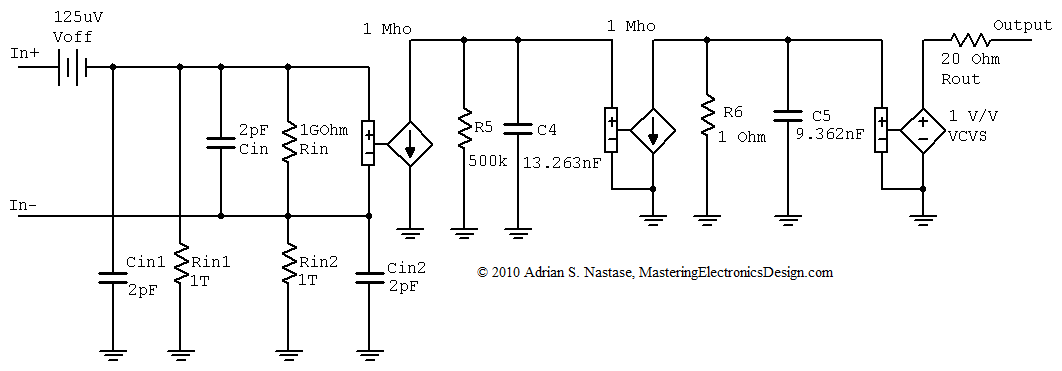
Why do you need to build your own Op Amp model? Most Op Amp manufacturers have SPICE models for their components and make them available for free. Then why should you know how to build one? Well, not everything has a model and that is why, sometimes, you have to build your own. Also, it may be necessary to study a circuit to see what happens if you change the Op Amp slew rate or bandwidth, offset, and so on. Sometimes the manufacturer own model does not work, as a user found out and posted a question in this forum. I told him that the model does not work and advised him to build his own. …

Read more ...

» 8 Comments


Tags: , , , , , , , , ,
Categories: Analog Design

An Ideal Operational Amplifier Simulation Model

Saturday, August 28th, 2010

Summary:

You worked hard on your schematic, you calculated everything, you feel confident that it will work. To be sure though, before committing the schematic to copper, you want to simulate it. You develop a SPICE simulation schematic and, surprise, things don’t work. What’s going on?

Read more ...

» 2 Comments


Tags: , , , , , ,
Categories: Analog Design

The RMS Value of a Trapezoidal Waveform – Part 2

Friday, July 23rd, 2010

Summary:

In a previous article, How to Derive the RMS Value of Pulse and Square Waveforms, I showed how to derive the RMS value of a pulse signal. In some applications, the trapezoidal signal plateau is not flat, but rather a ramp, as shown in Figure 1. A typical example is a DC-DC converter, where the transformer winding current might look like the signal in Figure 1. The waveform is still considered a trapezoidal waveform. Let’s calculate its RMS value.

Read more ...

» 1 Comment


Tags: , , ,
Categories: Analog Design, Waveforms

Using the Summing Amplifier as an Average Amplifier

Sunday, July 4th, 2010

Summary:

The summing amplifier can output the average of two, three or more signals. This is different than a signal average. The summing amplifier cannot, for example, output the average of a triangle signal. For that, you need an integrator to perform the average in the analog realm, or you need to sample the signal and calculate the average with a microcontroller. This type of average is the signal average in the time domain. I will write an article about the average of a signal in a near future.

Read more ...


Tags: , , , , , ,
Categories: Analog Design, Electronic Circuits Examples, Summing Amplifier, Waveforms

How to Derive the RMS Value of Pulse and Square Waveforms

Sunday, June 13th, 2010

Summary:

The RMS value of a pulse waveform can be easily calculated starting with the RMS definition. The pulse waveform is shown in Figure 1. The ratio t1/T is the pulse signal duty-cycle. As shown in other articles in this website (How to Derive the RMS Value of a Trapezoidal Waveform and How to Derive the RMS Value of a Triangle Waveform), the RMS definition is an integral over the signal period as in equation (1).

Read more ...


Tags: , , , ,
Categories: Analog Design, Waveforms

How to Derive the RMS Value of a Triangle Waveform

Monday, June 7th, 2010

Summary:

What is the RMS value of a periodic signal? When a periodic signal is generated by a source connected to a load, a resistor for example, the RMS value is the continuous signal, the DC value which would deliver the same power to the load as the periodic signal.

This article shows how to derive the RMS value of triangle waveforms with different shapes and duty cycles.

Read more ...


Tags: , , ,
Categories: Analog Design, Waveforms

« Previous Next »