


Unipolar to bipolar converters are useful when we have to have a unipolar component to do a certain job in a mixed signal design environment. For example, Digital to Analog Converters (DACs) may have the output voltage range 0 to 2.5 V, or 0 to 5 V, while the design asks for a range of –5 V to +5 V. To comply with this requirement, we have to design a unipolar to bipolar converter which will be inserted between the DAC output and the following bipolar stage. It looks like the circuit in Figure 1. How did I design it?
 Figure 1
The unipolar to bipolar converter design starts with writing down the requirements:
If Vin = 0 V, then Vout = –5 V.
If Vin = +5 V, then Vout = +5 V.
It is always a good idea to write down the specifications on your page top. You will see this behavior in all my articles. That way you have the design specifications in front of your eyes at all times while you pencil down your calculations. It also helps you to better “see” what is required, so that you do not stray off the course with some other calculations, while all you need is to reach your goal: a certain output voltage range for a given input range.
This circuit can be solved in two ways: A solution by reasoning on the design requirements and a math method. Let’s start by reasoning on the design requirements.
First, the output range doubles versus the input range. The input has a span of 5 V while the output has a span of 10 V. The immediate conclusion is that the converter gain has to be 2.
Second, if we multiply the input by a gain of 2, the output will swing between 0 and +10 V. However, our output range has to be –5 V to +5 V, so we will need to introduce an output offset of –5 V. If our voltage reference is +5 V for a DAC output of 0 to +5 V, it is clear that we need to subtract this voltage from the converter output. What Op Amp configuration performs subtraction? A differential amplifier.
Any linear circuit has a transfer function defined by gain and offset as in the following equation.
 |
(1) |
Since we know the gain and offset, we can write down the transfer function of the unipolar to bipolar converter.
 |
(2) |
The differential amplifier is shown in Figure 2,
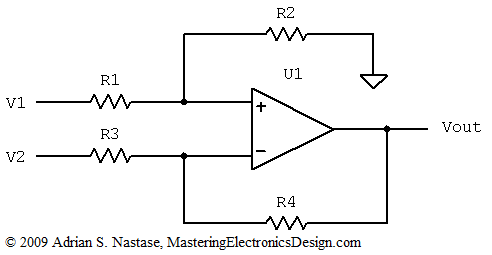 Figure 2
and its transfer function is as follows.
 |
(3) |
For the proof of this transfer function read How to Derive the Differential Amplifier Transfer Function.
Let’s compare equations (2) and (3). In equation (3), V1 becomes Vin. Also, we have a voltage +5 V reference in our system. Since we need to subtract 5 V from the circuit output we will make V2 = +5 V. If V2 is 5 V, then R4/R3 = 1. We can choose R3 = R4 = 10 kOhm.
One of the V1 factors in equation (3) is 1+R4/R3 = 2. Therefore, R2/(R1+R2) has to be one, so R1 = 0 and R2 can be anything, including no resistor. The final schematic of the unipolar to bipolar converter is the circuit in Figure 1.
>>> <<<
The math solution is a system of two equations with two unknowns. Starting with the design specifications we wrote earlier, the transfer function of the differential amplifier is written for both extremes of the output range:
 |
(4) |
Solving is simple. From the first equation, R4/R3 = 1. Then, from the second equation R2/(R1+R2) = 1, the same result as before.


 '
'
if the range of my input is 0-230 V. what should be the reference voltage??
You choose a reference voltage based on the input and output range. You gave me the input range, but I need the output range as well to give you advice. 230V? Is it DC? Sounds a lot for an Op Amp that usually works at maximum 36V. My point is, make sure that the voltage level that reaches the Op Amp is within it’s operating limits.
Hello I like the solution but I gess: If I have a signial to swing from 0V to 5V and need to convert it to -2.5 to +2.5V, I limit the output using a supply of +/-3V? or limit the out with 2 zener face to face? I cant figure it, could you help me?
Regards
You can do it both ways. First, you need to check what is the maximum allowed voltage in the input of the following stage. If you choose to limit the signal with the power supply, take into consideration what is the maximum output trip of the op amp. An op amp output cannot go to the power supply level, unless it is a rail-to-rail op amp. Then set your power supplies, both positive and negative accordingly.
If you choose to limit the output with zener diodes, the limiting value will be the zener voltage plus 0.6V, which is the forward voltage of the other zener diode. When limiting, the current through the diodes will be limited by op amp, usually at a current between 10 to 15 mA, depending on its short circuit specs. Therefore, you need to check what is the zener voltage at that current to use the correct part. You can decrease the current by inserting a small resistor between the op amp output and the diodes. You can use this resistor only if the following stage input impedance is high enough so that the limiting resistor does not count.
This article is just what I have been looking for. I have a strain gauge that has a 0 – 24 mV differential output. I have been using a ti INA117 to get a single ended output which I then feed to the non inverting pin on a ti INA114. I then run a voltage divider into the inverting pin of the INA114 to get my reference voltage. The output voltage has to be +/- 50mv. Is there an easier way to accomplish this?
You could use just INA114. INA114 is an instrumentation amplifier and it is designed for low offset, low drift. The input voltage trip is 24mV, while the output is 100mV (+/-50mV). So the gain should be 4.167. Set RG to 15.8k and connect the REF input to a 50mV voltage source. This 50mV source has to have a low output resistance, otherwise you will modify the output common-mode gain of the INA114. For 50mV reference you can use a voltage divider 10k with 41.2 ohms from a 12V supply. 41.2 ohms is small enough to not to introduce significant common-mode errors, but if the error is unacceptable then you will need an op amp to set this level. You need a positive 50mV reference for an inverting circuit, or a negative 50mV reference for a non-inverting one.
How to generate +2.5 and -2.5 voltages from a single +3 Volts Battery ?
You did not mention the output current of the +/- 2.5V supply and if it has to be regulated. Assuming it is low power, and unregulated, I would use a charge-pump DC to DC converter to invert the 3V supply. For example, Analog Devices ADM660 can do that. Once you have +/-3V, you can drop the voltage with diodes to about +/-2.45V, depending on the output current.
There are also regulated DC to DC converters like Maxim’s MAX889R for 3V input to negative regulated output voltage, and MAX1759 for 3V input to positive adjustable regulated output voltage.
Hi,
I found this article looking for a solution to drive a laser scanning mechanism from a DAC. The scanner takes a -10..10V input, while the DAC only outputs 0..5V.
I tried the calculator given a 5V reference voltage, but all I get is negative resistor values. Also, how do I choose R2 and R3?
I’m pretty comfortable with bits and bytes and high and low, but all this analog stuff is making me feel dizzy. Perhaps you could help?
If the solution has negative resistors, it means that physically the circuit is not possible. You need to change your input data to bring your resistors into the positive realm. Usually, dropping Vref will do. This is a Unipolar to Bipolar Converter. You can use this calculator:
https://masteringelectronicsdesign.com/differential-amplifier-calculator-2/
Type Vin1 = 0 and Vin2 = 5V for your input range, which is the DAC output. Choose V2 = 5V and Vref = 2.5V. Also, choose R2 = R3 = 10kohm. With these data, Vout will swing between -10V and +10V. The solution is R1 = 2.5kohm and R4 = 40kohm.
Thanks.
In the mean time, I’ve been studying confusing ‘technical details’ and have since discovered that an ILDA laser takes -5V..+5V as its input (and also an inverted signal) which means I can use the exact circuit you’re describing here. I finally got my hands on a -12..+12 dc-dc converter and was able to test it on my LM324N.
Thanks so much!
Glad to hear it.
Hi,
Can you tell which dc to dc convertor You used.
My requirement is -12, + 12 v DC , Current max -200 milli amp
I am not sure wether we can build something with OP AMP.
Thanks for your help.
Regards,
Rahul
Hi,
Yes, I used this one: http://www.newark.com/xp-power/ia0512s/dc-dc-conv-iso-pol-2-o-p-1w-12v/dp/88M0694
It’s a small SIL component that converts 5V into -12/+12V. It’s rated for 1W only (which is all I need, I hope) but I’m sure they have bigger ones in their range. There are other suppliers that have similar components as well.
Maybe this one does what you need:
http://www.newark.com/xp-power/jcd0505d12/dc-dc-conv-iso-pol-2-o-p-5w-12v/dp/62T2052
Hi,
I’m trying to build a circuit to convert a 0V to 5V output from an analog joystick to -5V to 5V.
(1) What should I connect to the positive and negative power supply pins of the Op-Amp? Do I connect 5V, ground, or something else?
(2) What Op-Amp should I choose? I found the following one, but I’m not sure what part of the specs I should look for. As long as the joystick’s converted output doesn’t have more than 1mV noise in <1kHz range, I would be happy enough. I guess I don't need or want a huge output current.
http://www.mouser.com/ProductDetail/Texas-Instruments/LMH6321MR-NOPB/?qs=sGAEpiMZZMtCHixnSjNA6M%252bbBaCn4IWbwBZuS4vckcA%3d
Thank you so much for the helpful post!
Yul
You need a bipolar to unipolar circuit for your application. This article:
https://masteringelectronicsdesign.com/design-a-bipolar-to-unipolar-converter/
describes exactly your circuit. As for the op amp selection, you need a rail-to-rail op amp to be able to power it at a single 5V supply. For example, Analog Devices AD8603, which you can buy from Mouser,
http://www.mouser.com/ProductDetail/Analog-Devices/AD8603AUJZ-REEL7/?qs=sGAEpiMZZMuUbyQTl9BuV4OiHa%252br%2fwQUC4runvGfhdA%3d,
has low noise and an output current up to 70 mA. You can connect the positive supply pin at +5V and the negative supply pin at 0V (GND).
You do not need the high power op amp you showed, unless you really need up to 300 mA output. That op amp is not rail-to-rail, and for 0 to +5V output you need a dual supply of +10V and -5V at 300 mA output. So, a rail-to-rail op amp will serve you better.
Hi Adrian,
Thank you so much for your answer! I think I misstated the problem. I need a 0 to 5V input and a -5 to +5V output, so it needs a uni-to-bipolar converter, not bi-to-unipolar.
Given that, would your advice stay the same for the op-amp and power supply?
Thank you again!
Yul
In the case of a unipolar to bipolar converter, things are different. Your op amp output needs to swing from -5V to +5V. As such, you need a dual power supply.
The power supply level depends on the op amp. If you choose a rail-to-rail op amp, you can power it at +5V and -5V. The op amp I showed you in the previous post will not work, because its maximum supply is 0 to 5V or +/-2.5V.
There are many op amps that work at higher voltage. For example, AD8638 can be powered up to +/-8V, but the output current is just 19mA maximum.
If you choose a non-rail-to-rail op amp, you have to power it higher than +5V and lower than -5V with a few volts to achieve the desired output swing. The datasheet will tell you the maximum output swing based on supply voltage.
That’s great information to have. But it leads me to another question: how do you get a -5V input for the power, when all you currently have are 0 (gnd) and +5V? To me it seems like a chicken-and-egg problem. How can I get around this?
You need a DC/DC converter. Go to Mouser and search for a converter from +5V to -5V. For example, I found RP-0505D from Recom Power. It has 100 mA output current capability. Of course, your 5V supply has to be capable of sourcing power for both +5V and -5V supplies.
Great work. Precise and brief.
One note: + Voffset in equation (1) should be – Voffset
Other than that I think you did a marvelous job
Thank you for your input. As for Voffset, the equation is correct. Voffset is an algebraic variable that can be positive or negative. In this case it is negative, with the value Voffset = -5V. Equation 1 is a general linear equation, as y = ax + b is the general linear equation in Algebra.
HELLO SIR
I AM USING ADE7878 IC IN ENERGY METER, IT REQUIRED (3 PHASE) FOUR PAIR OF FULLY DIFF. VOLTAGE INPUTS: IXP AND IXN. CURRENT SENSOR CIRCUIT ALSO PROVIDE IN ELVA. BOARD, BUT I’M USING ACS714 SENSOR. IT’S OUTPUT IS 0 TO 5V AND I’M USING ADC CIRCUIT AND CONVERT -0.5V TO +0.5V IN SINGLE PIN BUT IC REQUIRED PAIR OF INPUT.
MY QUESTION IS IF I SORT IXP AND IXN AND I GIVE ADC INPUT THE IC REFER +0.5V IN IXP AND -0.5V IXN….
AND THE OP-AMP WILL BE WORK OR NOT…
If you need to convert from a bipolar signal with the amplitude of +/- 0.5V to 0-5V, you need a bipolar to unipolar converter. Use this calculator to design it:
https://masteringelectronicsdesign.com/summing-amplifier-calculator-java/
Also, this article should help you:
https://masteringelectronicsdesign.com/design-a-bipolar-to-unipolar-converter/
Hello, I need to give a bipolar supply to the op amp integrator. For that i need to make my unipolar dc supply as bipolar. By using this circuit will i be able to make the supply. my output requirements are -18v and +18v and i can give input voltage from 0 to 36 v. I also see that in your circuit, you have a differential op amp which itself require a bipolar supply, how can we give that supply if we are itself making a bipolar supply.
Your 36V supply can be transformed into +18V with a DC-DC converter. Also, there are DC-DC converters that transform the +36V supply into a negative supply, in your case -18V. So, with one supply you can generate a +/-18V supply using DC-DC converters. Look for DC-DC converters at these manufacturers: https://masteringelectronicsdesign.com/semiconductor-manufacturers/
By connecting positive end of one supply to +ive end of op amp and other to the ground and similarly by connecting negative end of the second supply to the -ive end of the op amp and other end to the ground, can we get both +18v and -18v ?
If you have two independent floating 18V supplies, and you connect them as you described, it will work.
Also, I forgot to tell you , both the supplies have a voltage regulator, which can regulate the supplies to 18 V. But my only problem is how can i give -18 v to the -ive terminal of op amp. Will, attaching -ive terminal of the supply with -ive terminal of op amp work ?
This will not work. If the power supplies are not floating, and are referenced to ground, then you cannot make a negative supply from 2 positive ones. One of them has to be negative. There are negative voltage regulators like LM137 which output a negative voltage referenced to ground.
I need circuit with 0 to 10v input which will be converted to -5 to 5v,
please sujjest me the values of the R1 and R2, i need to take any extra precaustions when designing please sujjest me.
Just follow the steps in this article, considering that Vin is 0 to +10V. Since both input and output voltage span is 10 V, the gain is 1. The result is R4/R3 = 1 and R2/(R1+R2) = 1/2. Therefore, all resistors are equal.
Hello,
I’m trying to change a 0-5V digital signal to a -9V to +9V digital signal. I ran a spice simulation of the circuit without feedback and a simple voltage divider at 2.5v referenced to ground. The simulation works great but my actual circuit stays at +9V regardless whether the input is at 0V or 5V. The supply to the op amp is +9v / -9V referenced to the same common ground. Can you give me any hints at what I’m doing wrong. Do I actually need the feedback path even though the spice simulation says otherwise?
I think I finally found what I was looking for so long time. Big THANK YOU!
What can I do if I want to amplify bipolar signal -/+3mv to 0-3.3v? Is this possible?
Use the bipolar to unipolar calculator I published here:
https://masteringelectronicsdesign.com/summing-amplifier-calculator-java/
to calculate the resistors. However, to amplify such a small signal, better use an instrumentation amplifier, as I described in a post above.
I have a power supply with high voltage (could go to 80 V). It is a unipolar power supply and I need to convert it to bipolar.
Is there any circuit or device to use for that ?
You need a DC to DC converter to convert the positive voltage to a negative one. And you need a DC to DC converter to convert the positive voltage to whatever positive level you need. So you need 2 DC to DC converters to create a bipolar power look at Linear Technology/Analog Devices to find a suitable DC to DC converter.
Hi, I need to convert a 5V unipolar signal to a +/- 10V signal. I am stuck between trying to find something to do it for me or make my own circuit. My goal is to use an arduino to control the device i need the signal for. Any ideas on what is the best way to approach this? Thanks
What is the reference voltage you intend to use?
What is the advantage/disadvantage compared to this circuit:
http://www.ti.com/lit/ug/slau525/slau525.pdf
which needs only 3 resistors, not 4?
It is just a different circuit. TI uses a summing amplifier, and their circuit is designed for +/-10V output voltage. The circuit I described in this article uses a differential amplifier and it is designed for +/-5V output voltage.
Two part question:
Given that in a microprocessor based system, it takes some amount of time for the DAC to be established to its 2.5V, (using your example voltages) if my output can only handle voltages very near zero, (say +/- 200mV) what would you suggest to keep my output from destroying my later device which has about 1 ohm resistance?
The op amp that I have inherited is an OPA547F/500 and has a disable input that I have coupled to an opto circuit to get the correct levels. It seems to work but is pricey compared to a TLV4113. Do you see the TLV4113 doing the same job as the OPA547?
1. If the following stage has a 1 ohm resistance you can use a simple attenuator at the DAC output which will give you 0 to 200 mV for a DAC trip of 0 to 2.5V.
2. You can use TLV4113, provided that you lower the power supply to no more than 6V. TLV4113 is a dual op amp so the footprint is different than OPA547F. Also, TLV4113 has a lower output current, so you have to verify if that is ok for your application.
I really like your page and I am just getting into electronics. Maybe you can help.
I need to take a 0-5v input and have the output be 5 to 0v. Basically at 0v input I need 5v output and at 5v input I need 0v output. will this converter work for this situation?
Use the circuit shown in this article, MasteringElectronicsDesign.com:How to Derive the Transfer Function of the Inverting Summing Amplifier. All resistors are 10k. The input is V1. V2 has to be -5V to offset the output.
This is an awesome tutorial, Adrian! I have used this circuit in the past because a legacy circuit required a sensor output to have a range of -5 to 5V, and my new sensor output had a 0 to 5V output. (Exactly like your example.) I am using this circuit again with a new sensor that has an output range of 0 to 1.8V but needs to be converted to -5 to 5V so it will interface with my existing circuitry. This tutorial has and will continue to help many electronic techs and electrical engineers.
Thank you, Fred.