


Bipolar to Unipolar Converter Example
The calculator solves the summing amplifier resistors based on the input and output voltage range requirements. It is a great tool to design a bipolar to unipolar converter, as an example and other circuits.
Enter the input range, Vin1 to Vin2, the output range, Vout1 to Vout2 and a reference voltage Vref which helps in adjusting the common-mode level of the amplifier. Since the 2-input summing amplifier has 4 resistors, you need to choose two resistors, R1 and R3, and calculate R2 and R4. For more details about this calculator read How to Design a Summing Amplifier Calculator.
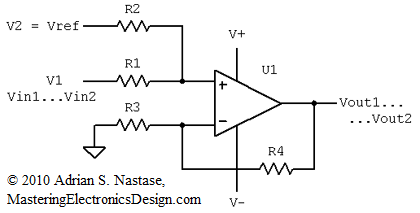
Given Input Range
| Vin1 = | V | Vin2 = | V |
Required Output Range
| Vout1 = | V | Vout2 = | V |
Choose a Reference Voltage
| V2 = | V |
Choose R1 and R3
| R1 = | kOhm | R3 = | kOhm |
Calculate R2 and R4
| R2 = | kOhm | R4 = | kOhm |
| JavaScript by Glenn Stevenson |
The default values show a bipolar to unipolar converter with the input range -5V to +5V and output 0 to 3V. If the results are negative or infinity you need to change the input data. Read How to Design a Summing Amplifier Calculator for help.


 '
'
Cool! I used it to design my bipolar to unipolar converter. Thanks.
Great! Can any one tell me what op amp should i use for +/-24V to 0/5V signal conversion?
Thanks!
In this case the op amp output will swing between 0 and 5V, and the inputs between 0 and 4.5V (this value depends on voltage reference). So any op amp that can take power supplies above 5V will do. Make sure to look into the opamp specs to see what power supply is needed for a 5V output level, for the load you need. Also, don’t forget that the opamp can reach 0V at its output only if the op amp is powered with a bipolar supply. However, the negative supply needs to be just a few volts below ground, depending on op amp.
My main concern is to avoid bipolar power supply. I don’t need 0 Volts output i can leave with 1Volt or more. What i cannot understand, is the inputs that i have are – 24 to +24 Volts what power supply should i have and at what spec should i look at the datasheet? Also, the positive power supply of the op amp, needs to be greater that the output, or greater that the inputs?
Please help!
Well, you can use an op amp which is powered with a positive supply, say TLC272. Its power supply can be between 3V to 16V. Look in its datasheet, at VOH, High-level output voltage. If the op amp is powered at 5V, the output can only go up to 3.2V, on a 10k load. Therefore, the power supply has to be higher, at minimum 7.5V for the output to reach 5V. The other spec is VOL, Low-level output voltage which is 50mV. So, the output will not reach 0V, but 50mV, which is fine, as you said in your post.
Again, the op amp power supply needs to be higher than the output maximum voltage with about 2.5V. This bipolar to unipolar converter has an input voltage of +/-24V, but the power supply of TLC272 needs only be 7.5V.
Hi, I am using UA741CP as the op-amp.
My input is -4 to 4V and the desired ouput is 0-5V.
I have tried using the calculator and got R1=10k, R2=15k, R3=10k, R4=1.5k.
I am using 9V battery as the supply voltage (+ wire to V+ and – wire to V-).
However, the result is:
– Vout = 0 when Vin = 0.
– Vouto = 2.22V (455 bit out of 1023 bit) when Vin = 5V.
Please help me, thank you!
What is your reference voltage? If the op amp input goes negative, you need a negative power supply as well. Connect another 9V battery with the negative pole to V- and the positive pole to ground and your circuit should work as desired.
How to shift the following voltages:
+5V to -5V -> 0V to -5V
I can apply any reference voltage.
Use the calculator in this article. Vin1 = 5V, Vin2 = -5V, Vout1 = 0V, Vout2 = -5V. Choose a reference voltage V2 = -2.5V to shift the output below 0V.
Hello,
I tried the circuit for an input range of -1V to 4V with an output of 0V to 5V
and a ref voltage is 2.5V.
It half works. With an input of zero the output is 1V which is correct but the output is not linear and does not correspond to the input Voltage +1V. As the input goes up the output goes up but by less and less with increased input voltage.
My goal to have 0 to 5V to feed a ADC from a -1 to 4V input (Both 5V range)
Any ideas?
Thank you.
If the input range is -1V to 4V, you need to have a bipolar power supply for your op amp. If your op amp is rail-to-rail both input and output, you need at least a -2V supply to allow its output to go to 0V and its input to take a -1V signal. Also a +6V positive supply so that the output can go to +5V.
If it is not rail-to-rail, a negative voltage -5V and positive of +10V will do.
Thank you very much, great tool, nice explanation. Your site saved me a ot of time!
Glad to hear that.
Very efficient calculator while using LT1635 chip and LTspiceXVII to simulate it as well.
I’m glad you liked it.
An excellent Calculator! It has saved me a lot of design time.
2 comments: The comments and procedure seem to be “print locked”. I am very old school and have a difficult time following a procedure that is not printed material.
This calculator is also very valuable for my work; Can I buy this app so that I can install it on my PC?
I am glad it helped.
No, you cannot buy it. You can come back here and use it anytime you need. Just let the very few ads to be displayed to support this website.