Articles for the ‘Operational Amplifier Formulas’ Category

« Previous

Apply Thevenin’s Theorem to Solve a Negative Resistance Circuit, or Current Source

Monday, February 14th, 2011

Summary:

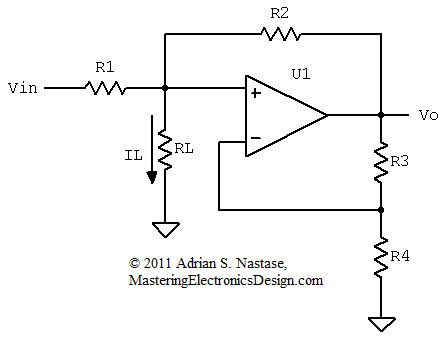
The circuit in Figure 1 is a good example of applying Thevenin’s Theorem to solve a circuit with dependent supplies. It is a negative resistance circuit and it was posted in this forum with a call for solution verification for IL as a function of Vin. Since this fits very well with my plans to write more about Thevenin’s Theorem, I decided to post the solution here.

Read more ...

» 5 Comments


Tags: , , , ,
Categories: Analog Design, Electronic Circuits Examples, Operational Amplifier Formulas, Thevenin's Theorem

An Op Amp Gain Bandwidth Product

Monday, October 18th, 2010

Summary:

I can see some chat on internet about the operational amplifier gain bandwidth product. People are interested in having a better understanding of this parameter, as it appears in any op amp datasheet and it is used in many articles and books. In this article I will describe this parameter and show you an example with Analog devices’ ADA4004, which is a precision amplifier.

Read more ...

» 19 Comments


Tags: , , , , ,
Categories: Analog Design, Operational Amplifier Formulas

The Non-Inverting Amplifier Output Resistance

Wednesday, December 23rd, 2009

Summary:

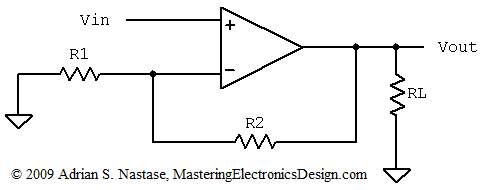
It is customary to consider the output resistance of the non-inverting amplifier as being zero, but why is that? An Op Amp’s own output resistance is in the range of tens of ohms. Still, when we connect the Op Amp in a feedback configuration, the output resistance decreases dramatically. Why?

Read more ...

» 2 Comments


Tags: , , , , ,
Categories: Analog Design, Operational Amplifier Formulas

How to Derive the Inverting Amplifier Transfer Function

Thursday, November 26th, 2009

Summary:

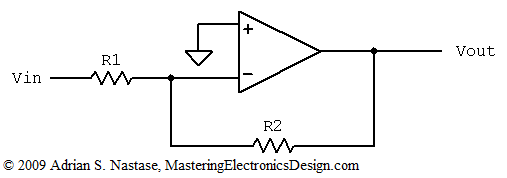
Widely used in Analog Design, the inverting amplifier in Figure 1 has a simple transfer function. What is the proof of this function?

Read more ...

» 2 Comments


Tags: , , , , ,
Categories: Analog Design, Operational Amplifier Formulas

How to Derive the Non-Inverting Amplifier Transfer Function

Saturday, August 29th, 2009

Summary:

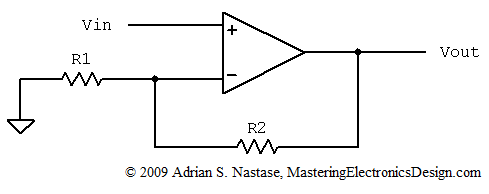
One of the most common amplifiers in Analog Design is the non-inverting amplifier. How do you derive its transfer function?

Read more ...


Tags: , , , ,
Categories: Analog Design, Operational Amplifier Formulas

Useful Operational Amplifier Formulas and Configurations

Sunday, August 23rd, 2009

Summary:

A compilation of Op Amp configurations and transfer functions.

Read more ...

» 4 Comments


Tags: , , , , , , ,
Categories: Analog Design, Operational Amplifier Formulas

How to Derive the Transfer Function of the Inverting Summing Amplifier

Monday, August 17th, 2009

Summary:

The inverting summing amplifier does exactly what its name says: adds the input signals and inverts the result. This amplifier presents a major advantage versus the non-inverting summing amplifier. The input signals are added with their own gain. The disadvantage is the inversion of the sum, which might not be desirable in some cases. How can we derive this function? What is the transfer function of the inverting summing amplifier with 3, 4, or n inputs? This article answers all these questions.

Read more ...


Tags: , , ,
Categories: Analog Design, Operational Amplifier Formulas, Summing Amplifier, Superposition Theorem

« Previous