Articles for the ‘Differential Amplifier’ Category

« Previous

A Summing and Differential Amplifier with One Op Amp

Sunday, April 18th, 2010

Summary:

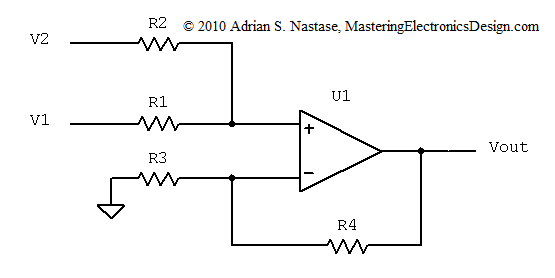
In a comment, one of my readers asked me what is the transfer function of the non-inverting summing amplifier in Figure 1, when R3 is connected to a reference voltage instead of ground. Well, this is a summing amplifier with a differential configuration.

Read more ...

» 3 Comments


Tags: , , ,
Categories: Analog Design, Differential Amplifier, Summing amplifier, Superposition Theorem

Differential Amplifier Output Common-Mode Voltage Calculator

Sunday, February 28th, 2010

Summary:

A differential amplifier frequent use is the amplification of the voltage difference between its input signals, while rejecting the common-mode level. However, the output common-mode level cannot be zero. The operational amplifier technological limitations, as well as the outside resistor tolerances let the common-mode voltage to make it to the amplifier output as an output error. As a consequence, the amplifier output voltage is the input signal difference times gain, plus the output common-mode voltage.

Based on the resistor tolerances, this calculator will show the output common-mode voltage, Vocm, and the total voltage, Vout, at the differential amplifier output. Vocm will alter the ideal output voltage, which can be calculated when the resistors are perfectly matched.

Read more ...


Tags: , , , , ,
Categories: Analog Design, Calculators, Differential Amplifier

How to Design a Circuit from its Transfer Function Graph

Sunday, February 21st, 2010

Summary:

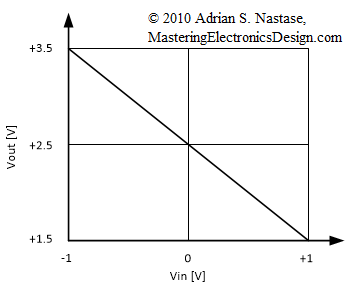
Sometimes all we know about a circuit is its transfer function graph. The transfer function might look like the one in Figure 1. How can we design a circuit so that its input-output behavior will match the graph?

Read more ...


Tags: , , , , ,
Categories: Analog Design, Differential Amplifier, Electronic Circuits Examples

Differential Amplifier Calculator

Sunday, February 7th, 2010

Summary:

If you need to design a differential amplifier, here is a handy calculator. All you need to define are the input range, the output range and a choice of a voltage reference. The default values for this calculator are set for a unipolar to bipolar converter.

Read more ...


Tags: , , , , , ,
Categories: Analog Design, Calculators, Differential Amplifier

Design a Differential Amplifier the Easy Way with Mathcad

Thursday, November 19th, 2009

Summary:

For those of you who have Mathcad, designing a differential amplifier is really easy.

Let’s say you need to design a unipolar to bipolar converter and you decide to use a differential amplifier for this task. You know the input and output voltage range and you need to calculate the resistors based on a voltage reference you have in the system. All you have to do is to create a Mathcad file for a quick response. Then store it some place for future designs.

Read more ...

» 6 Comments


Tags: , , , , , ,
Categories: Analog Design, Differential Amplifier, Electronic Circuits Examples

Design a Unipolar to Bipolar Converter for a Unipolar Voltage Output DAC

Monday, November 2nd, 2009

Summary:

Unipolar to bipolar converters are useful when we have to have a unipolar component to do a certain job in a mixed signal design environment. For example, Digital to Analog Converters (DACs) may have the output voltage range 0 to 2.5 V, or 0 to 5 V, while the design asks for a range of –5 V to +5 V. To comply with this requirement, we have to design a unipolar to bipolar converter which will be inserted between the DAC output and the following bipolar stage.

Read more ...


Tags: , , , , , , , ,
Categories: Analog Design, Differential Amplifier, Electronic Circuits Examples, Mixed-Signal Design

How to Derive the Instrumentation Amplifier Transfer Function

Sunday, August 30th, 2009

Summary:

The Instrumentation Amplifier (IA) resembles the differential amplifier, with the main difference that the inputs are buffered by two Op Amps. Besides that, it is designed for low DC offset, low offset drift with temperature, low input bias currents and high common-mode rejection ratio. These qualities make the IA very useful in analog circuit design, in precision applications and in sensor signal processing.

Read more ...


Tags: , , , , ,
Categories: Analog Design, Differential Amplifier, Superposition Theorem

« Previous