Articles Tagged ‘dependent sources’

The Non-Inverting Amplifier Output Resistance

Wednesday, December 23rd, 2009

Summary:

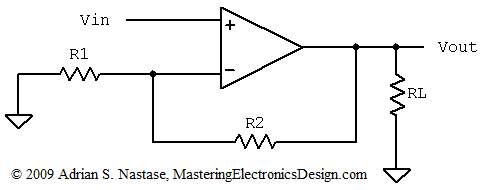
It is customary to consider the output resistance of the non-inverting amplifier as being zero, but why is that? An Op Amp’s own output resistance is in the range of tens of ohms. Still, when we connect the Op Amp in a feedback configuration, the output resistance decreases dramatically. Why?

Read more ...


Tags: , , , , ,
Categories: Analog Design, Operational Amplifier Formulas

The Common-Collector Amplifier Input and Output Resistance – The Proof

Monday, October 12th, 2009

Summary:

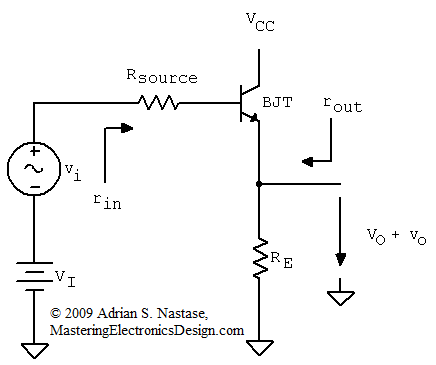
In this article I will show a method to deduce the input and output resistance of the common collector amplifier. The common-collector amplifier is a well known circuit (see Figure 1). It is mostly used as a buffer due to its high input resistance, small output resistance and unity gain buffer. The equations derived in this article are symbolic, as is the derivation of any other formula in this website. Still, even if the resistances’ values are not numeric, the equations are intuitive enough to show the high input low output resistance property of the amplifier.

Read more ...

» 1 Comment


Tags: , , , , , , , , ,
Categories: Analog Design, Thevenin's Theorem, Transistor Circuits

Derive the Transfer Function of the Common Collector Amplifier with Thevenin’s Theorem

Sunday, October 4th, 2009

Summary:

How to Apply Thevenin’s Theorem for Solving Circuits with Dependent Sources.

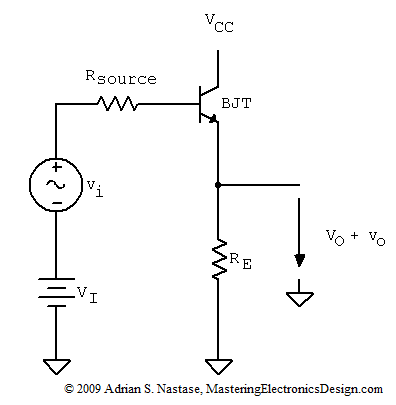
Besides its use to simplify and calculate currents in electrical circuits, Thevenin’s Theorem is also a great tool that we can use to derive transfer functions. This article will illustrate how to derive the small signal transfer function of the Common-Collector Amplifier with bipolar junction transistors (BJTs).

The circuit is shown in Figure 1. It is also called a repeater, so we expect that the calculated transfer function to be close to unity gain.

Read more ...


Tags: , , , , , , , , , ,
Categories: Analog Design, Thevenin's Theorem, Transistor Circuits