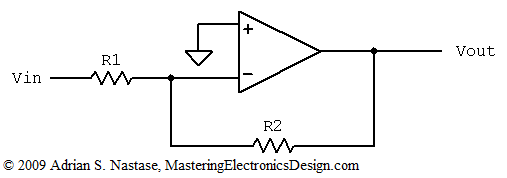
Figure 1
Widely used in Analog Design, the inverting amplifier in Figure 1 has a simple transfer function.

What is the proof of this function?


Figure 1
Widely used in Analog Design, the inverting amplifier in Figure 1 has a simple transfer function.
What is the proof of this function?
For those of you who have Mathcad, designing a differential amplifier is really easy.
Let’s say you need to design a unipolar to bipolar converter and you decide to use a differential amplifier for this task. You know the input and output voltage range and you need to calculate the resistors based on a voltage reference you have in the system. All you have to do is to create a Mathcad file for a quick response. Then store it some place for future designs.
If you would like to know why the unipolar to bipolar converter can be designed with a differential amplifier, read this article, Design a Unipolar to Bipolar Converter for a Unipolar Voltage Output DAC .
Let’s take an example.
Unipolar to bipolar converters are useful when we have to have a unipolar component to do a certain job in a mixed signal design environment. For example, Digital to Analog Converters (DACs) may have the output voltage range 0 to 2.5 V, or 0 to 5 V, while the design asks for a range of –5 V to +5 V. To comply with this requirement, we have to design a unipolar to bipolar converter which will be inserted between the DAC output and the following bipolar stage. It looks like the circuit in Figure 1. How did I design it?
 Figure 1
Most Analog to Digital Converters have a unipolar input that can be a problem when designing bipolar circuits. Some common ADC input voltage ranges are 0 to 2.5 V, or 0 to 5 V. However, the analog circuit that drives the ADC can have voltage swings of, –1 V to +1 V, –2 V to +2 V , –5 V to +5 V, and so on. Bringing the ADC input below ground is a big No-No, because the current from input will flow through the chip substrate creating irreversible changes in the ADC and damage it. So, how do we connect a bipolar front end circuit with a unipolar ADC? Enters the bipolar to unipolar converter. Let’s design one.
The converter can be designed with a summing amplifier, as in Figure 1. How do we calculate the resistors?
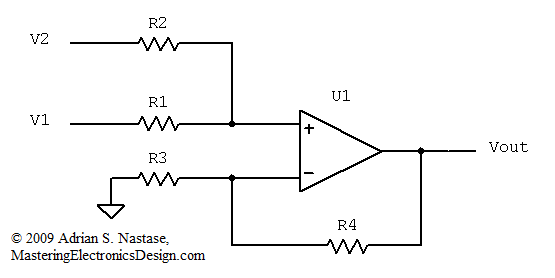
Figure 1
The summing amplifier, or the non-inverting summing amplifier, is an analog processing circuit with the transfer function (the summing amplifier formula as some say) shown in the following equation.
 |
(1) |
The first term of the product is the actual summing, while the second term is a gain due to the R3 and R4 resistors. I prefer this type of summing amplifier as shown in Figure 1, because it is more flexible and allows us to achieve any linear function we want.
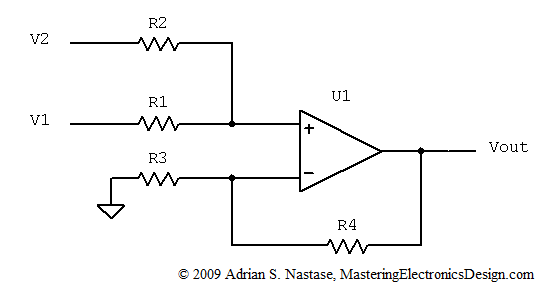
Figure 1
Some authors prefer the following schematic,
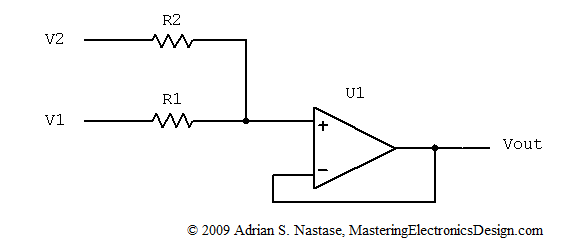
Figure 2
with the transfer function
 |
(2) |
One can see that the summing amplifier in Figure 2 is a subset of my preferred schematic in Figure 1. In Figure 2, R4 is zero, while R3 is infinity (open connection). It performs the analog summation between V1 and V2, with a gain of 1. Therefore, the amplifier in Figure 1 gives us more choices when designing a function with this circuit. If the gain is not needed, this should come up from calculations, as in this article Solving the Summing Amplifier.
If you followed this website, by now you probably figured that I am not a promoter of learning formulas by heart. I like to derive the transfer function if I need it. So, how do we prove this formula?
We will use the Superposition Theorem, which says that, the effect of all the sources in a circuit is equal with the sum of the effects of each source taken separately in the same circuit. Therefore, if we take out one source, V2, and replace it with a wire, we then can find the voltage in each node and the current in each branch of this circuit due to the remaining source V1. Then we do the same with V1 and then sum up the currents on each branch and the voltage levels on each node. We are only interested in Vout, so this should be simple.
We will first make V2 = 0V, by connecting R2 to ground, as in Figure 3.
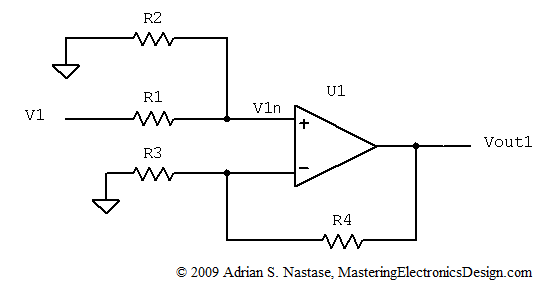
Figure 3
The Op Amp is considered an ideal component, so that the input bias currents are negligible. If the current in the non-inverting input is zero, R1 and R2 make a voltage divider for V1. The non-inverting input voltage V1n, can be written as
 |
(3) |
and, based on the non-inverting amplifier transfer function, Vout1 is
 |
(4) |
By replacing V1n in (4), the output voltage is
 |
(5) |
In the second part of my demonstration, based on the Superposition Theorem, R2 is connected back to V2 and V1 = 0, by connecting R1 to ground. Following the same train of thought Vout2 can be written as
 |
(6) |
Now we have to add Vout1 to Vout2 to complete the third step of the Superposition Theorem. After factorizing the gain component 1+R4/R3, the summing amplifier transfer function becomes the mathematical relation shown in (7).
|
(7) |
Q.E.D.
>>> <<<
This formula shows that this sum is a weighted sum between V1 and V2. This is better than a direct sum V1 plus V2, because, again, brings flexibility in design. Together with the differential amplifier, this circuit brings another treat in the art of electronics design.
Is there any link between a differential amplifier and a summing amplifier? Yes, it is. They can be easily converted one into the other one. While this article shows the conversion, the main purpose is to demonstrate how the same circuit can be viewed as a differential amplifier or as a summing amplifier, depending on the voltage levels in its inputs.
The differential amplifier is shown in Figure 1. It is mostly used to measure the voltage difference between its inputs. In addition, it can be used to achieve a linear function Vout(Vin) (Vout of Vin) where Vout is the voltage at the amplifier output, and Vin is the input voltage. In this case, any one of the inputs V1 or V2 can play the role of Vin. For details, read my articles Solving the Differential Amplifier Part 1, Part 2, and Part 3.
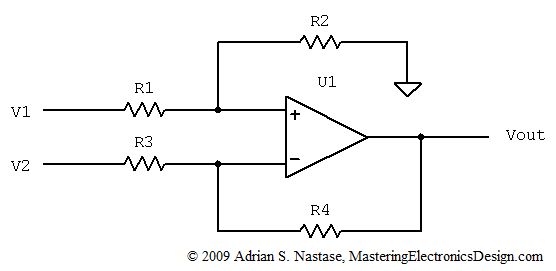
Figure 1
What is interesting about the differential amplifier, which I call a universal amplifier, is that it can be easily converted into a summing amplifier. In fact, they are one and the same circuit. In Figure 2 I drew the summing amplifier, where I noted the voltage levels at its inputs with Vs1 and Vs2. If you would like to read more about the summing amplifier go to this link: Solving the Summing Amplifier.
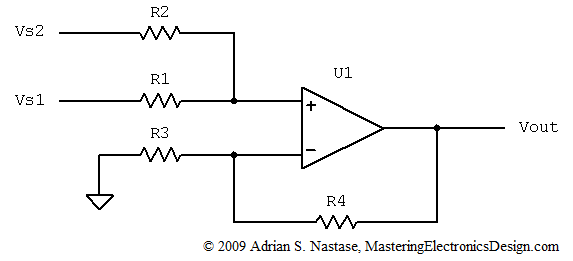
Figure 2
The differential amplifier can be seen as a summing amplifier, if we look at it differently. If, in Figure 1, we take R2 and move it on the left side of the OpAmp, as in Figure 2, without affecting its connections, the differential amplifier looks like a summing amplifier. The only difference is that, the differential amplifier sums V1 with a zero voltage, because R2 is connected to ground. Also, R3 is connected to V2 instead of being connected to ground.
Therefore, to convert the differential amplifier into a summing amplifier, all we have to do is to adjust the voltage levels as follows:
Of course, these steps may be done backwards, if we need to convert a summing amplifier into a differential amplifier.
What about the transfer function of the summing amplifier? Can we easily derive it as well from a differential amplifier transfer function? Of course we can, and here is how.
The differential amplifier transfer function is shown in (1).
 |
(1) |
As I already said, the differential amplifier is a summing amplifier between V1 and zero volts, and with V2 = 0. Let’s rewrite the transfer function (1) as follows:
 |
(2) |
Why did I add 0V at V1 times the resistor ratios? Because, as I explained in The Differential Amplifier Transfer Function, any voltage on the non-inverting input multiplies the R4, R3 ratio plus one.
Now, if we connect R1 to Vs1 and connect R2 to Vs2, the transfer function becomes
 |
(3) |
where by k I noted the resistor ratio for Vs2. Using the Superposition Theorem, we realize that Vs2 “sees” a voltage divider made by R1 and R2, with the ratio of
 |
(4) |
For details on how to determine this ratio, read my article How to Derive the Summing Amplifier Transfer Function.
Replacing k in equation (3), we arrive at the summing amplifier transfer function as shown in equation (5).
 |
(5) |
Q. E. D.


 '
'