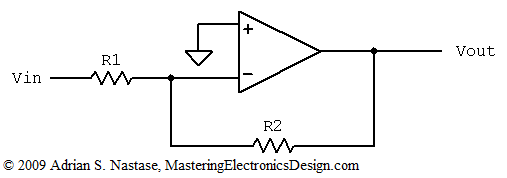
Figure 1
Widely used in Analog Design, the inverting amplifier in Figure 1 has a simple transfer function.

What is the proof of this function?


Figure 1
Widely used in Analog Design, the inverting amplifier in Figure 1 has a simple transfer function.
What is the proof of this function?
In this article I will show a method to deduce the input and output resistance of the common collector amplifier. The common-collector amplifier is a well known circuit (see Figure 1). It is mostly used as a buffer due to its high input resistance, small output resistance and unity gain. The equations derived in this article are symbolic, as is the derivation of any other formula in this website. Still, even if the resistances’ values are not numeric, the equations are intuitive enough to show the high input, low output resistance property of the amplifier.
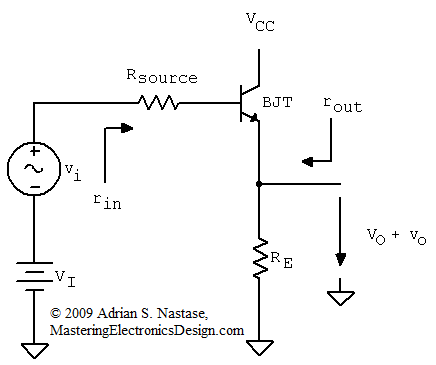
Figure 1
Besides its use to simplify and calculate currents in electrical circuits, Thevenin’s Theorem is also a great tool that we can use to derive transfer functions. This article will illustrate how to derive the small signal transfer function of the Common-Collector Amplifier with bipolar junction transistors (BJTs).
The circuit is shown in Figure 1. It is also called a repeater, so we expect that the calculated transfer function to be close to unity gain.
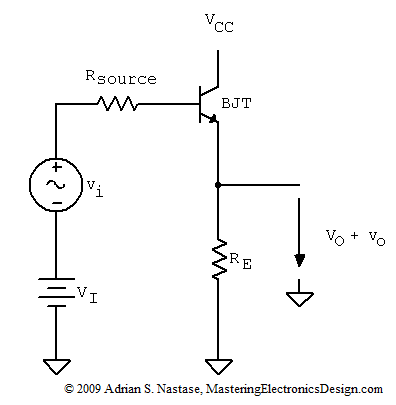
Figure 1
The Instrumentation Amplifier (IA) resembles the differential amplifier, with the main difference that the inputs are buffered by two Op Amps. Besides that, it is designed for low DC offset, low offset drift with temperature, low input bias currents and high common-mode rejection ratio. These qualities make the IA very useful in analog circuit design, in precision applications and in sensor signal processing.
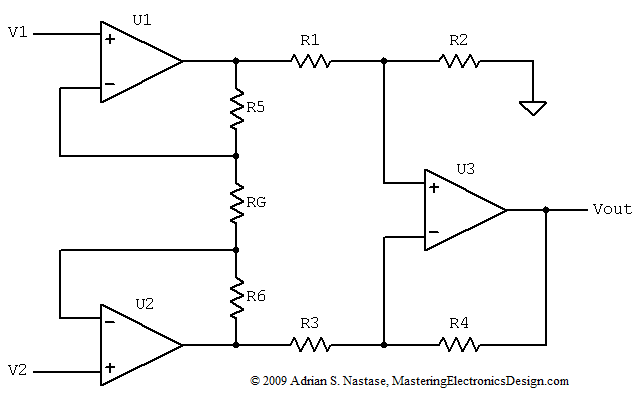
Figure 1
Figure 1 shows one of the most common configurations of the instrumentation amplifier. Its clever design allows U1 and U2 operational amplifiers to share the current through the feedback resistors R5, R6 and RG. Because of that, one single resistor change, RG, changes the instrumentation amplifier gain, as we will see further. RG is called the “gain resistor”. If the amplifier is integrated on a single monolithic chip, RG is usually left outside so that the user can change the gain as he wishes. One example of such instrumentation amplifier is Texas Instruments’ INA128/INA129.
The inverting summing amplifier does exactly what its name says: adds the input signals and inverts the result. This amplifier presents a major advantage versus the non-inverting summing amplifier. The input signals are added with their own gain. The disadvantage is the inversion of the sum, which might not be desirable in some cases.
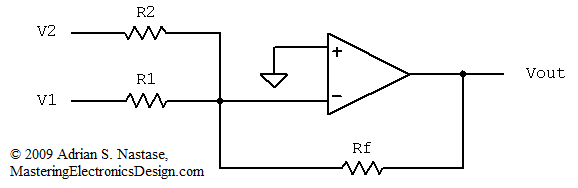
Figure 1
Figure 1 shows the non-inverting summing amplifier with two inputs. Its transfer function is shown in equation (1).
 |
(1) |
As you can see, this is a simple function. Each signal is added with its own gain created by the feedback resistor, Rf, and the corresponding resistor for that signal. But, why is that? Why is this transfer function a lot simpler than the non-inverting summing amplifier? How can we derive this function? What is the transfer function of the inverting summing amplifier with 3, 4, or n inputs? This article answers all these questions.
In a previous article, How to Derive the Summing Amplifier Transfer Function, I deduced the formula for the non-inverting summing amplifier with two signals in its input. But what if we have 3, 4 or an n number of signals? Can we add them all with one amplifier?
Theoretically, yes. Practically, it is a different story. There is a practical limit on how many signals can be summed up with one amplifier. When the number of input signals grows, each signal component in the sum decreases in value. By the end of this article you will understand why.
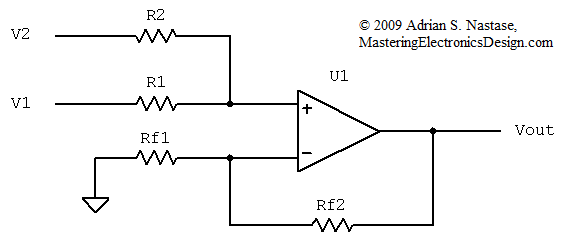
Figure 1
We already saw that, for a summing amplifier with two input signals (Figure 1), the transfer function is
 |
(1) |
If we need to add 3 signals, the circuit schematic looks like the one in Figure 2. What is the transfer function of this summing amplifier with 3 inputs?
The summing amplifier, or the non-inverting summing amplifier, is an analog processing circuit with the transfer function (the summing amplifier formula as some say) shown in the following equation.
 |
(1) |
The first term of the product is the actual summing, while the second term is a gain due to the R3 and R4 resistors. I prefer this type of summing amplifier as shown in Figure 1, because it is more flexible and allows us to achieve any linear function we want.
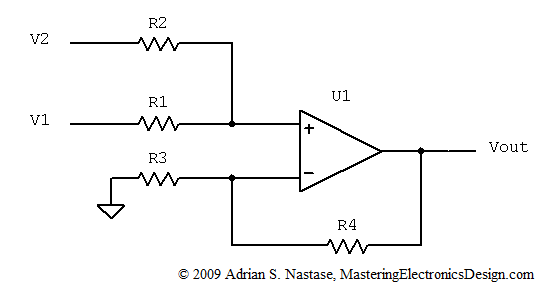
Figure 1
Some authors prefer the following schematic,
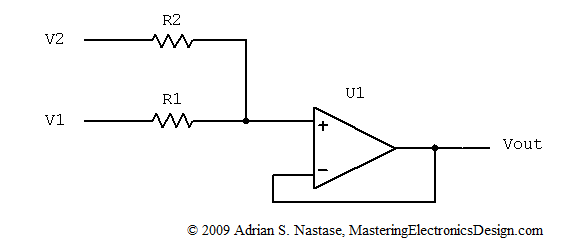
Figure 2
with the transfer function
 |
(2) |
One can see that the summing amplifier in Figure 2 is a subset of my preferred schematic in Figure 1. In Figure 2, R4 is zero, while R3 is infinity (open connection). It performs the analog summation between V1 and V2, with a gain of 1. Therefore, the amplifier in Figure 1 gives us more choices when designing a function with this circuit. If the gain is not needed, this should come up from calculations, as in this article Solving the Summing Amplifier.
If you followed this website, by now you probably figured that I am not a promoter of learning formulas by heart. I like to derive the transfer function if I need it. So, how do we prove this formula?
We will use the Superposition Theorem, which says that, the effect of all the sources in a circuit is equal with the sum of the effects of each source taken separately in the same circuit. Therefore, if we take out one source, V2, and replace it with a wire, we then can find the voltage in each node and the current in each branch of this circuit due to the remaining source V1. Then we do the same with V1 and then sum up the currents on each branch and the voltage levels on each node. We are only interested in Vout, so this should be simple.
We will first make V2 = 0V, by connecting R2 to ground, as in Figure 3.
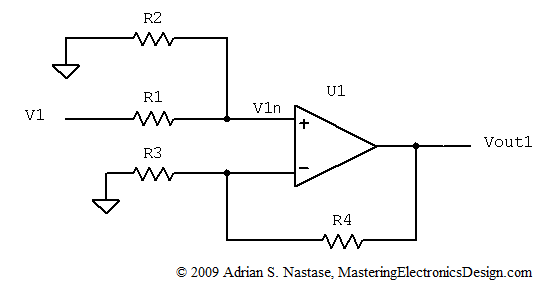
Figure 3
The Op Amp is considered an ideal component, so that the input bias currents are negligible. If the current in the non-inverting input is zero, R1 and R2 make a voltage divider for V1. The non-inverting input voltage V1n, can be written as
 |
(3) |
and, based on the non-inverting amplifier transfer function, Vout1 is
 |
(4) |
By replacing V1n in (4), the output voltage is
 |
(5) |
In the second part of my demonstration, based on the Superposition Theorem, R2 is connected back to V2 and V1 = 0, by connecting R1 to ground. Following the same train of thought Vout2 can be written as
 |
(6) |
Now we have to add Vout1 to Vout2 to complete the third step of the Superposition Theorem. After factorizing the gain component 1+R4/R3, the summing amplifier transfer function becomes the mathematical relation shown in (7).
|
(7) |
Q.E.D.
>>> <<<
This formula shows that this sum is a weighted sum between V1 and V2. This is better than a direct sum V1 plus V2, because, again, brings flexibility in design. Together with the differential amplifier, this circuit brings another treat in the art of electronics design.


 '
'